Liquid cooling systems
The spread of High Performance Computing is causing a dramatic increase in the density of thermal power to be dissipated, and liquid solutions, of the immersion or contact type, are needed to extract heat. CAREL offers high-performance control solutions specifically designed for these systems.

CDU, the heart of the system
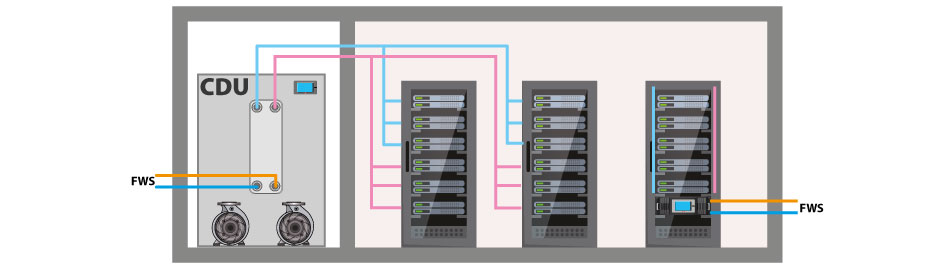
The heart of the system is the CDU (Coolant Distribution Unit), which, through a heat exchanger, transfers the heat extracted from the chips by a liquid (usually water and propylene glycol) or a two-phase fluid, to the FWS or Facility Water System, which disposes of the heat into the environment using a chiller or dry cooler according to environmental conditions. An Evaporative Cooling system can increase system efficiency and, in particular, CAREL's Chillbooster, implementing atomisation technology, minimises water consumption. Some CDUs convey heat to an air exchanger through fans installed directly in the server room, and environmental air conditioning is needed in these cases. This type of equipment is sometimes known as an HDU (Heat Dissipation Unit).
c.pCO electronic controls
The variety of systems equipped with multiple controlling and monitoring devices (exchangers, pumps, filters, etc.) requires the use of high-performance programmable controllers. CAREL offers a range of solutions for controlling different types of CDUs, including in-rack versions with a compact controller, such as c.pCOmini, and floor-mounted CDUs with c.pCO controllers. The latter are available in various sizes and equipped with dual Ethernet ports to create machine networks with flying masters, for synergistic operation and redundancy. The high connectivity of these controllers also means being able to manage devices in series and at the same time, on other communication ports, to share data with monitoring systems over the most common protocols.
The new STone programming suite is the ideal tool for creating application software in a versatile environment for generating high-quality, secure code.
The controllers can be combined with various user interfaces, but the graphical touchscreen displays are ideal, given the multiplicity of information to be displayed.

Sensors and the new pCOe A-In
 CDUs and liquid cooling applications in general are highly critical due to their low system inertia. Therefore, measuring temperature, pressure, and the state of devices, such as filters (differential pressure), accurately is extremely important. This implies the use of multiple, often redundant sensors to compare readings and ensure system operability even in the event of a probe failure.
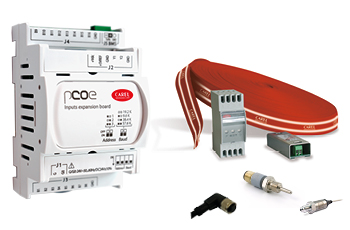
The new expansion board is the ideal option for controllers because it allows up to 16 analogue inputs to be added in just four DINs, divided into four groups to read multiple pressure transducers and other active probes, as well as simple NTCs.
Boss One and Boss micro
 The adoption of a liquid cooling solution is often based on a strong interaction with the servers. For this reason, the cooling system must be complemented with an EDGE device capable of communicating with DCIM systems using the same security standards and sophisticated interfacing methods, such as the Redfish protocol, carried across from the server world. boss one is the ideal solution for this task. It is compact and extremely powerful at the same time. The plug-in board for the c.pCO family allows an Ethernet connection, which is entirely independent of the controller. boss micro is the standalone solution for interfacing all kinds of devices with the same systems.
Find out more about the CAREL offering for liquid cooling systems:
Read the brochure Discover the application


